Rooftop Tent Hire Kenya gives independent travelers an affordable and flexible way to combine a…
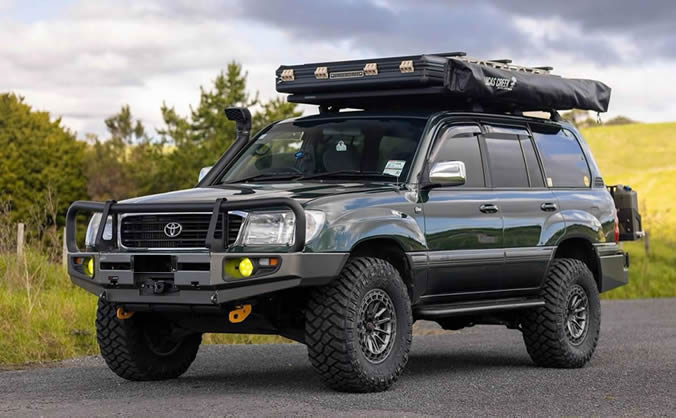
Uganda self-drive roof-tent safari car hire
Exploring Uganda with your own 4×4 creates a very different safari experience. Rather than moving between destinations according to a fixed guided-tour timetable, Uganda self-drive car hire gives travelers the freedom to decide when to leave, where to stop and how quickly to move through the country. Add a roof-top tent, camping equipment and a capable Land Cruiser, and the rental vehicle becomes much more than transport. It becomes the foundation of an independent African road trip.
Uganda suits this style of travel particularly well because extraordinary landscapes occur within one country. A journey can move from the open savannahs of Lake Mburo National Park into the mist-covered hills surrounding Bwindi Impenetrable National Park. After gorilla trekking, the route can continue through Queen Elizabeth National Park before reaching Kibale’s forests, crater lakes and chimpanzee country. Travelers with more time can extend their journey north toward Murchison Falls or even the remote landscapes of Kidepo Valley.
A roof-top tent adds another dimension. Instead of depending entirely on lodges, adventurous travelers can stay at recognized campsites and carry their sleeping space wherever the road takes them. Therefore, accommodation becomes part of the vehicle rather than a completely separate element of the safari.
However, independence requires sensible preparation. Uganda’s main highways can be straightforward, while rural roads and national-park tracks may change considerably after rain. Mountain routes around Bwindi demand more concentration than city driving. Furthermore, long distances between destinations mean that unrealistic itineraries can quickly turn an enjoyable holiday into a tiring sequence of transfers.
This guide examines Uganda self-drive car hire from every important angle. It covers roof-top tents, Land Cruiser options, camping equipment, national parks, road conditions, itinerary planning, cross-border travel, insurance, fuel, campsites and practical preparation. Whether you plan a short Bwindi adventure or a multi-week Uganda road trip, the aim is to help you choose the right vehicle and build a journey that actually works.
Why Uganda Self-Drive Car Hire Is Ideal for Independent Safaris
Freedom is the most obvious advantage of driving yourself, but it is not the only one.
On a conventional safari, the driver-guide controls much of the daily movement. Departure times are normally agreed in advance, accommodation is fixed, and major transfers follow the itinerary prepared before arrival. For many guests, this is exactly the convenience they want.
Independent travelers often prefer something different.
With Uganda self-drive car hire, there is more space for spontaneous decisions. Perhaps a beautiful viewpoint appears beside the road and you want twenty minutes for photographs. Maybe a roadside market looks interesting, or you discover a lake where an additional night would improve the journey. Because you are responsible for the vehicle, those decisions become easier.
Photography also benefits from a less rigid schedule. Instead of leaving simply because the transfer must continue, travelers may wait for better light or enjoy a landscape at a slower pace.
Furthermore, privacy is another advantage. Couples and families travel in their own space without a guide sharing every hour of the road trip.
Nevertheless, self-drive travel is not automatically better than a guided safari. It is better suited to people who genuinely enjoy driving, navigation and independent decision-making. If those responsibilities sound stressful, hiring the same type of safari vehicle with a professional driver may provide a more enjoyable holiday.
What Is a Roof-Top Tent Safari Vehicle?
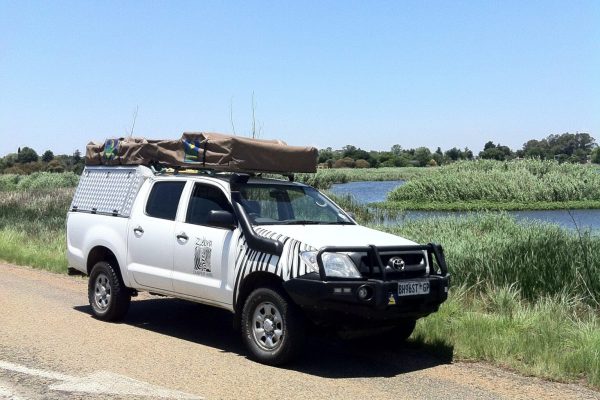
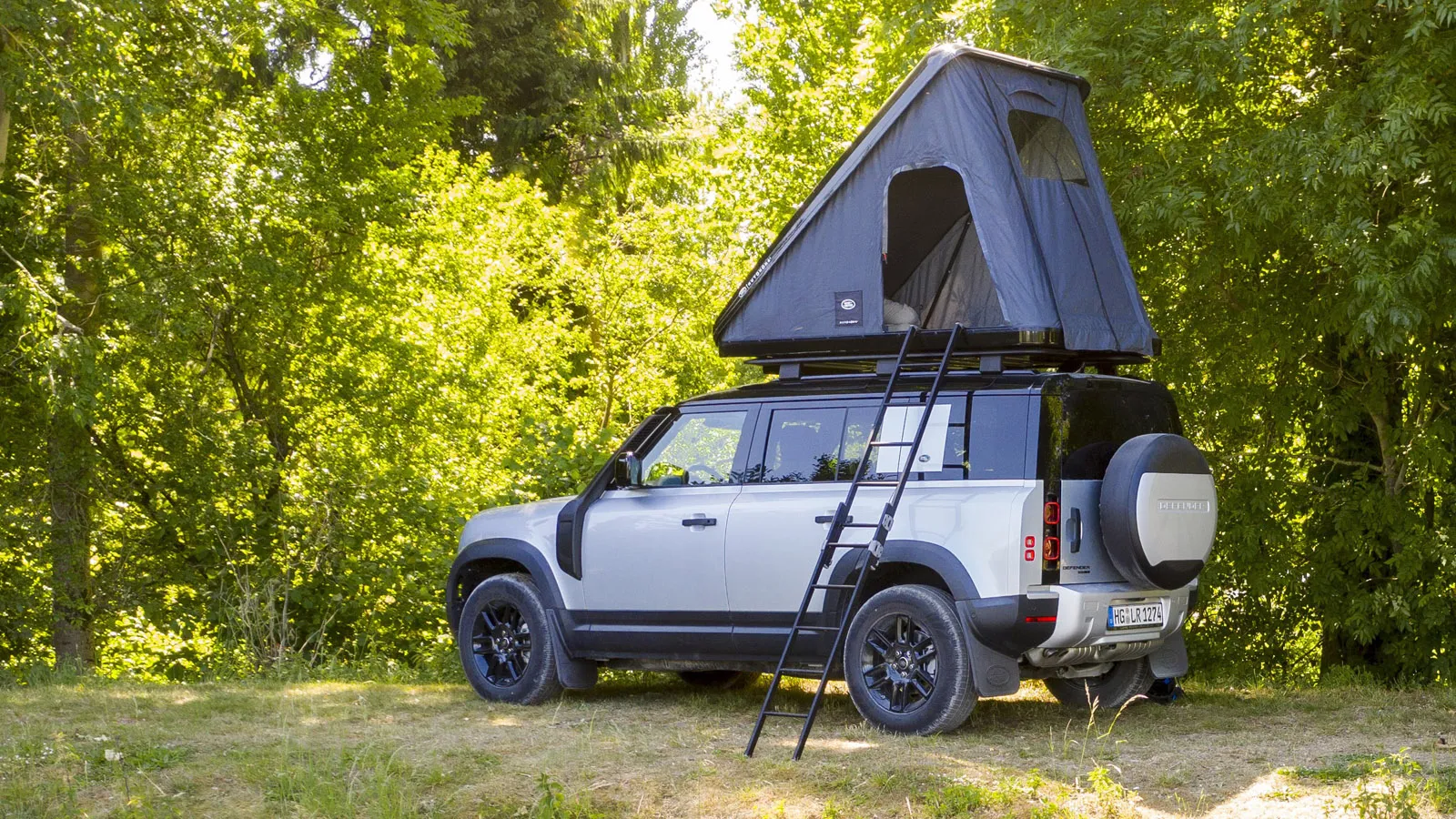
A roof-top tent safari vehicle is normally a proper four-wheel-drive SUV or expedition vehicle with a tent secured to a roof rack.
During road travel, the tent remains folded and covered. Once the vehicle reaches a campsite, travelers open the system, extend the sleeping platform and position the access ladder. Most rental roof tents include a mattress, ventilation panels and mosquito-screened windows.
Consequently, there is no need to carry a large sleeping tent inside the luggage area.
Being elevated above the ground also has practical benefits. Rain can leave campsites muddy, especially during wetter periods. A roof-mounted sleeping platform remains level and dry once the vehicle itself is correctly positioned.
Moreover, setup usually becomes quick after several nights of practice.
A standard roof tent commonly works best for two adults. Families and groups, on the other hand, may require two tents or a larger camping configuration.
Importantly, a roof-top tent should never be confused with a pop-up safari roof. A sleeping tent provides accommodation, whereas a pop-up roof is mainly designed to improve visibility during wildlife drives.
Uganda Self-Drive Car Hire and the Right 4×4
Vehicle selection is one of the most important decisions in a self-drive safari.
Uganda has many paved highways, yet some of its most rewarding destinations require travelers to leave those highways. Dirt tracks, murram roads, steep mountain approaches and national-park routes can all feature within one itinerary.
For this reason, ground clearance matters.
Four-wheel-drive capability matters as well.
A strong suspension, good tires and sufficient space for camping equipment are equally important.
Toyota Land Cruisers dominate the safari-rental market for understandable reasons. They offer strong off-road capability, widely understood mechanical systems and several body configurations suitable for camping.
However, not every Land Cruiser is identical.
Comfort, luggage space, fuel consumption and transmission vary considerably between models.
Uganda Self-Drive Car Hire With a Land Cruiser Prado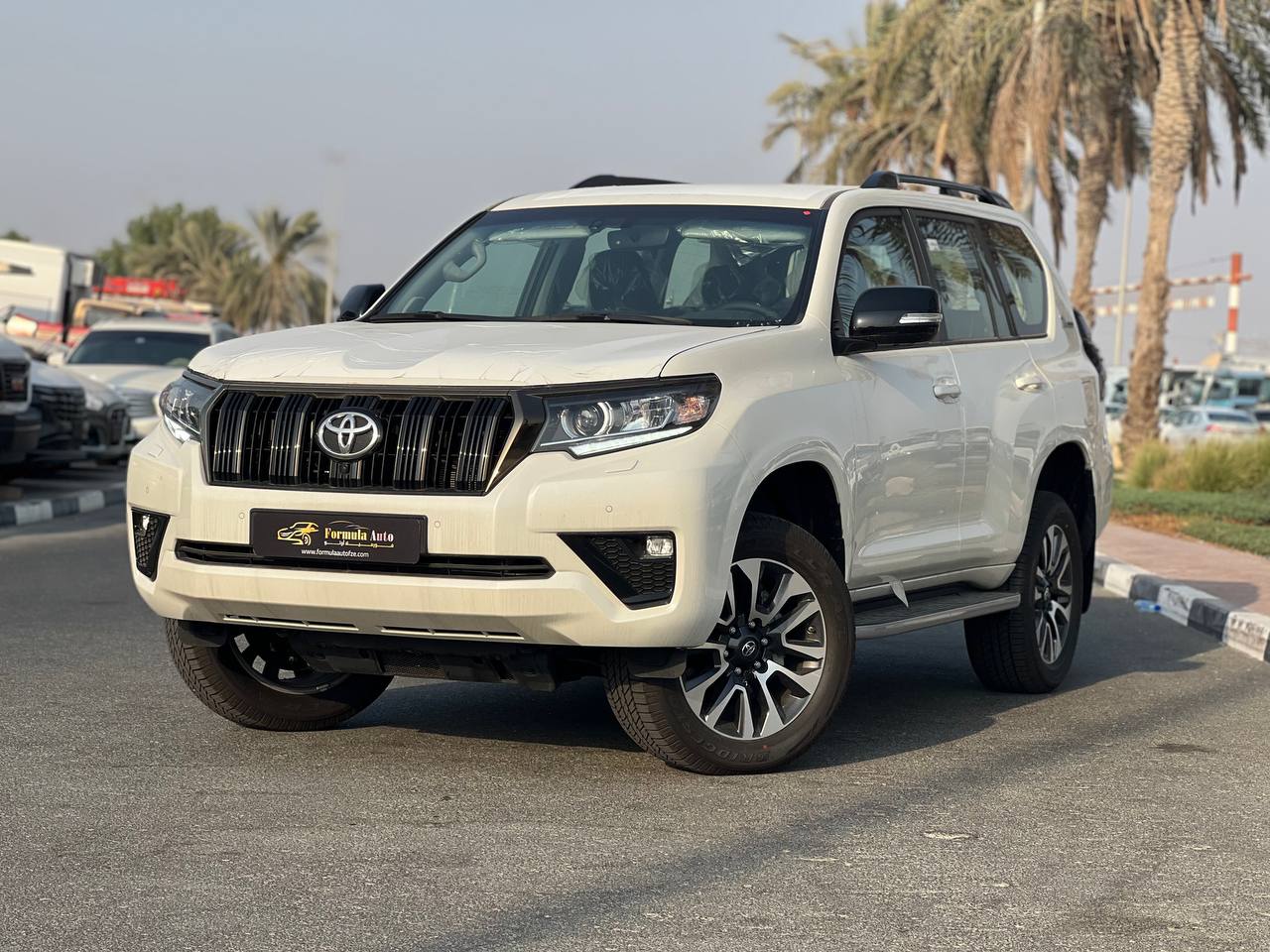
The Toyota Land Cruiser Prado is an excellent all-round option for couples and small groups.
Its biggest advantage is balance. The vehicle remains comfortable during long highway journeys while still providing genuine 4WD ability for more demanding routes.
Automatic Prados are particularly attractive to travelers accustomed to automatic transmission. Instead of concentrating on unfamiliar gear changes, the driver can focus on navigation and road conditions.
A properly fitted roof tent normally works well for two guests.
Meanwhile, the rear luggage area can accommodate personal bags, food and camping equipment when everything is packed efficiently.
For itineraries linking Entebbe, Lake Mburo, Bwindi, Queen Elizabeth and Kibale, the Prado is often a practical middle ground between a small SUV and a heavy expedition vehicle.
Fuel use is also generally easier to manage than with some larger petrol Land Cruisers, although exact consumption depends heavily on the engine, driving style, weight and road conditions.
Uganda Self-Drive Car Hire With a Land Cruiser 76 or 78
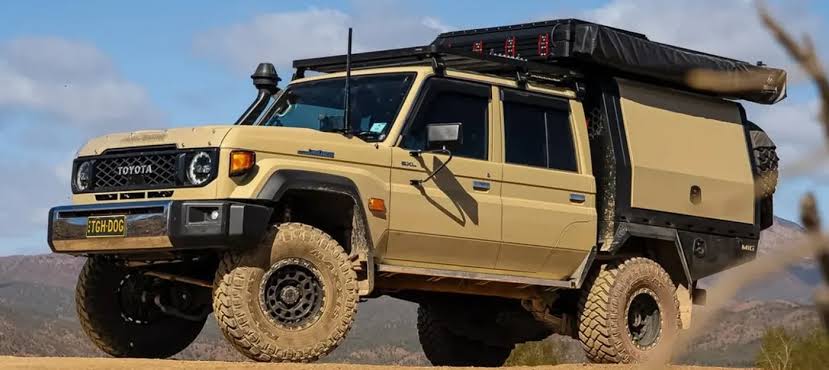
Longer overland journeys may justify choosing a more expedition-oriented Land Cruiser.
The 76 and 78 Series models are built around durability rather than luxury. Their interiors can feel more functional than a modern Prado, yet that simplicity is part of their appeal.
Storage is one major advantage.
Food boxes, recovery equipment, water and camping supplies require substantial room during a multi-week road trip. Hardtop Land Cruisers can handle that equipment without turning the passenger cabin into a permanent pile of luggage.
Furthermore, their robust construction suits more remote itineraries.
Travelers considering Kidepo Valley or an extended East African journey may therefore prefer this style of vehicle.
However, comfort expectations matter. Someone who values quiet highway cruising and modern interior features may still prefer a Prado or V8.
Uganda Self-Drive Car Hire With a Land Cruiser V8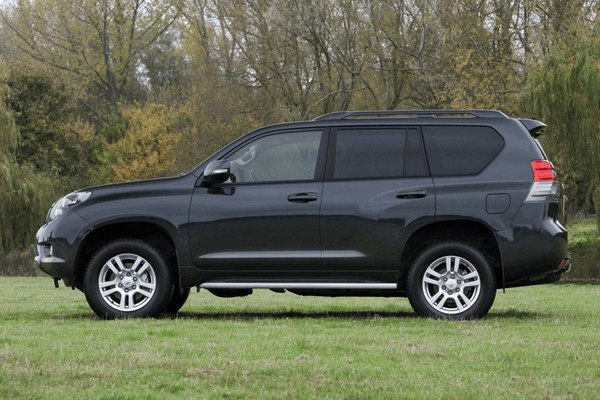
A Land Cruiser V8 offers a more refined road-trip experience.
The cabin is spacious, the engine provides strong performance, and automatic transmission is common. Consequently, long transfers can feel considerably easier.
For travelers who want independence without giving up much road comfort, the V8 can be appealing.
The obvious trade-off is fuel consumption.
Large petrol engines need more fuel, especially when the vehicle carries a roof tent, luggage, water and camping equipment.
Therefore, compare the entire trip budget rather than looking only at the rental rate.
A cheaper daily rental may ultimately cost more in fuel, while a slightly more expensive diesel model could perform differently over a long itinerary.
Uganda Self-Drive Car Hire With a Toyota Hilux
A double-cab Toyota Hilux offers a different camping layout.
Passengers remain in the main cabin while equipment can be stored in the rear pickup area or underneath a fitted canopy.
This separation is especially useful on long trips because food boxes, dirty camping equipment and recovery gear do not need to occupy the same space as passenger luggage.
A professionally fitted roof tent can sit above the rear section or another approved mounting system.
Consequently, couples who enjoy expedition-style travel may find a Hilux extremely practical.
Nevertheless, always check the exact configuration before booking. A vehicle being described as a Hilux does not automatically mean it carries the roof rack, tent or secure storage required for your journey.
Uganda Self-Drive Car Hire: Roof Tent or Pop-Up Roof?
Choosing between a roof-top tent and a pop-up safari roof depends on what you want the vehicle to do.
A roof tent solves an accommodation problem.
At camp, it opens into a sleeping platform and essentially turns the 4×4 into a mobile camping base.
A pop-up roof solves a wildlife-viewing problem.
When raised, it allows passengers to stand inside the vehicle and photograph animals from a higher position.
Some safari travelers assume the two systems are interchangeable. They are not.
In fact, certain extended safari vehicles are designed around large pop-up viewing roofs and cannot conveniently carry roof-top sleeping tents.
Therefore, tell the rental provider exactly what matters most.
If the main goal is an independent camping adventure, prioritize the roof tent.
If you expect to stay entirely in lodges and want the best possible game-viewing configuration, a pop-up roof may make more sense.
Travelers who need both functions should ask whether a suitable combination is available rather than assuming it exists.
Uganda Self-Drive Car Hire and Camping Equipment
A roof tent by itself is not a complete camping setup.
Daily life becomes much easier when the vehicle includes useful equipment for cooking, sitting, food storage and water management.
A typical camping package may contain folding chairs, a table, cooking pots, plates, mugs, cutlery, a gas burner, basic kitchen tools and water containers. Bedding may also be included, although this varies between providers.
A refrigerator is one of the most valuable additions.
During a multi-day safari, keeping food and drinks cold reduces the need to shop constantly. Fresh ingredients also last longer, which becomes particularly helpful on routes where major supermarkets are several days apart.
Nevertheless, never assume that the words “full camping gear” mean exactly what you expect.
Before paying a deposit, request a written equipment list.
That simple step prevents arriving at the vehicle handover and discovering that bedding, a fridge or cooking utensils cost extra.
Uganda Self-Drive Car Hire Costs: What Determines the Price?
There is no single correct daily rate for a roof-top safari vehicle.
Current competitors advertise everything from older Prado configurations to large hardtops and premium Land Cruisers, with the quoted price changing substantially according to vehicle model and equipment. Uganda Car Rentals
Rental duration is one factor.
Long bookings frequently receive lower daily rates than very short hires.
Vehicle type is another. A Prado generally falls into a different price category from a newer V8 or expedition hardtop.
Tent configuration matters as well. A vehicle with two tents for a family may cost more than a single-tent couple’s setup.
In addition, consider camping equipment, fridge rental, insurance, cross-border paperwork and one-way relocation.
The cheapest headline price is therefore not necessarily the cheapest complete trip.
Instead, compare quotations on a like-for-like basis.
A properly maintained vehicle with strong roadside support may deliver far better value than an unusually cheap Land Cruiser with old tires and limited backup.
Uganda Self-Drive Car Hire Insurance
Insurance deserves careful attention before departure.
Do not assume that “fully insured” means every possible type of damage is covered.
Rental agreements may treat tires, windscreens, underbody damage, roof tents and camping equipment differently from normal collision damage.
Water crossings may also create exclusions if the driver acted negligently.
Therefore, read the policy conditions and ask about the insurance excess.
The excess is the amount for which the renter may remain responsible after an insured incident.
Cross-border journeys require additional attention.
If you plan to drive from Uganda into Rwanda or begin in Kigali and continue into Uganda, confirm that the vehicle’s insurance is valid in every country on the itinerary.
Get important confirmations in writing.
Doing so is much easier than trying to resolve a misunderstanding after an accident or vehicle-damage claim.
Driving Documents for Uganda Self-Drive Car Hire
Travelers should confirm the driving documents required for their nationality before arrival.
A valid home driving licence is fundamental. Depending on the licence language, nationality and applicable rules, an international driving permit may also be useful or required.
Because regulations can change, check current requirements rather than depending on an old travel forum.
Keep your passport details, rental agreement, insurance papers and vehicle documents accessible during the trip.
Cross-border travelers should be particularly organized because immigration and customs officials may ask to see vehicle authorization documents at the frontier.
Again, a professional rental provider should explain what is supplied for the vehicle itself.
The traveler remains responsible for personal immigration and driving documentation.
Uganda Self-Drive Car Hire and Road Conditions
Road conditions are one of the biggest reasons to avoid planning a safari only through online mapping times.
Between major towns, paved roads may allow straightforward progress.
However, the character of a route can change dramatically during the final section toward a national park, campsite or mountain destination.
Bwindi provides an excellent example.
Uganda Wildlife Authority specifically recommends four-wheel-drive vehicles on several approaches to the park. The route from Ishasha toward Buhoma is largely dirt, while approaches through Ruhija and Nkuringo involve winding murram and mountainous roads. Uganda Wildlife Authority
Therefore, 100 kilometers in the highlands cannot be treated the same way as 100 kilometers on a major highway.
Build margin into travel days.
If navigation suggests arrival at 5:30 p.m., that leaves very little room for fuel stops, roadworks, rain or a wrong turn.
Earlier arrivals are safer and more relaxing.
Uganda Self-Drive Car Hire During the Rainy Season
Rain changes the road rather than simply making the scenery wetter.
A dry murram surface can become slippery after a storm. Deep ruts may fill with water, while steep tracks become more demanding.
Consequently, rainy-season driving requires patience.
Reduce speed before problems appear.
Use the vehicle’s four-wheel-drive system appropriately, but remember that 4WD does not cancel the laws of physics.
A heavy Land Cruiser can still slide.
If a road appears badly flooded or damaged, stop somewhere safe and ask for current local information.
Sometimes the longer route is the better route.
Moreover, avoid creating pressure by planning a fixed activity immediately after a difficult transfer.
When the schedule has room to breathe, changing roads because of weather becomes a minor inconvenience instead of a crisis.
Why Night Driving Should Be Avoided
Uganda is far more enjoyable when driving days finish before darkness.
Rural roads may include pedestrians, bicycles, motorcycles and livestock.
Potholes and unmarked road damage also become harder to identify at night.
Meanwhile, mountainous roads add steep edges and sharp bends.
Wildlife areas introduce another concern because animals can cross roads unexpectedly.
For these reasons, plan conservatively.
An early start is usually preferable to a late finish.
Arriving in daylight also makes campsite setup easier. Instead of searching for equipment with a headlamp, you can choose a level parking position, open the roof tent and organize dinner without rushing.
Uganda Self-Drive Car Hire Fuel Planning
Fuel should be managed proactively.
There is little benefit in waiting for the warning light before searching for a filling station.
Whenever a reputable station appears at a sensible point in the journey, consider topping up.
Fuel consumption varies dramatically between vehicles.
Engine type matters, but so do road conditions, load and driving style.
A large petrol Land Cruiser carrying two tents consumes very differently from a diesel Prado traveling lightly.
Therefore, ask the rental provider for a realistic consumption estimate for the exact vehicle.
Remote routes require additional planning.
If supplementary fuel must be carried, use approved containers supplied or recommended by the rental company.
Never improvise with unsafe plastic containers.
Uganda Self-Drive Car Hire Water and Food Planning
Water deserves the same attention as fuel.
Carry enough drinking water for everyone, plus additional capacity for basic cooking and campsite needs.
A reusable jerrycan or approved water container is far more practical than filling the vehicle with dozens of small bottles.
Food planning can remain simple.
Larger towns offer opportunities to buy bread, vegetables, fruit, rice, pasta, drinks and other basics.
Therefore, there is rarely a need to purchase two weeks of food at the beginning of the journey.
Instead, restock as the road trip progresses.
A roof-tent safari also does not require cooking every meal.
After gorilla trekking or a particularly long drive, eating at a nearby lodge or restaurant may be more enjoyable.
A flexible combination of camping meals and prepared meals usually works best.
Uganda Self-Drive Car Hire and Safe Camping
Roof-top camping feels adventurous, yet campsite choice should remain disciplined.
Use recognized campsites or properties that explicitly allow camping.
Do not assume that an empty roadside clearing is suitable simply because there appears to be space.
Private land requires permission.
Protected areas have their own regulations.
Most importantly, national parks contain real wildlife.
Camping rules exist because elephants, buffaloes, hippos and other animals do not understand human expectations about campsite boundaries.
Once at camp, listen to staff instructions.
Food should be stored responsibly, rubbish should be removed or placed in appropriate bins, and nighttime movement should follow local safety guidance.
A roof tent elevates your sleeping platform, but it does not make irresponsible behavior safe.
Uganda Self-Drive Car Hire for Bwindi Impenetrable National Park
Bwindi is one of the strongest reasons to rent a capable 4×4 in Uganda.
The forest itself is world famous for mountain gorilla trekking, yet the surrounding highlands also make the journey memorable.
Terraced farms cover steep hillsides.
Clouds move through forested ridges.
Small communities appear along winding roads.
Therefore, arriving by road provides a broader sense of the region than simply flying to a nearby airstrip and transferring directly to a lodge.
Vehicle choice matters because UWA recommends 4WD on several routes into the park. Uganda Wildlife Authority
Nevertheless, even the best Land Cruiser cannot compensate for rushed mountain driving.
Approach bends carefully, allow room for local traffic and arrive before dark whenever possible.
Uganda Self-Drive Car Hire and Bwindi Gorilla Sectors
A common self-drive mistake is treating Bwindi as though it has one central entrance.
It does not.
Gorilla trekking operates from different sectors around the forest.
Therefore, your confirmed trekking location should determine where you sleep the previous night.
A campsite on the wrong side of the park can create a long and stressful early-morning transfer.
This is especially important because mountain roads make straight-line distances misleading.
Plan the permit first.
Then choose the overnight location.
Finally, build the driving route around both.
That order prevents unnecessary backtracking.
Uganda Self-Drive Car Hire for Buhoma
Buhoma lies on the northern side of Bwindi and connects particularly well with Ishasha.
As a result, travelers coming from Queen Elizabeth National Park can create a natural route between savannah wildlife and gorilla trekking.
The wider Buhoma area provides different styles of tourist accommodation.
Roof-tent travelers should contact their intended property or campsite beforehand and confirm that camping is accepted.
Do not assume that every lodge with a car park permits overnight camping.
A confirmed campsite also gives you access to information about the latest local road conditions.
That can be extremely valuable after periods of heavy rain.
Uganda Self-Drive Car Hire for Ruhija
Ruhija appeals to travelers interested in mountain scenery, gorilla trekking and birding.
However, the approach can involve slow highland driving.
UWA describes the Kabale–Ruhija–Buhoma route as winding murram and recommends a 4WD vehicle. Uganda Wildlife Authority
Consequently, online travel times should be treated as estimates rather than promises.
If the road is wet, allow additional time.
The reward is a beautiful part of Bwindi where the journey itself feels distinctly different from driving across Uganda’s open plains.
Uganda Self-Drive Car Hire for Rushaga and Nkuringo
Southern Bwindi works especially well within itineraries approaching from Kisoro or Rwanda.
Rushaga and Nkuringo can also combine naturally with Lake Mutanda and other attractions around Kisoro.
According to UWA, routes toward Nkuringo involve mountainous murram roads where 4WD is recommended. Uganda Wildlife Authority
Therefore, travelers should avoid overly ambitious transfer days in this region.
Spend time in the southwest.
A slower itinerary creates room for a lake visit, community experience or simply a relaxed evening after gorilla trekking.
Uganda Self-Drive Car Hire for Queen Elizabeth National Park
Queen Elizabeth National Park provides an excellent contrast to Bwindi.
After spending time among mountain forests, travelers move into open savannah landscapes.
UWA places the park about 410 kilometers west of Kampala and notes that a direct road journey can require at least seven to eight hours. Uganda Wildlife Authority
That long distance explains why Queen Elizabeth works best as part of a multi-stop western circuit rather than a rushed standalone day.
From Bwindi, however, the route can be much more logical.
Ishasha lies in the southern part of Queen Elizabeth and forms a natural connection from northern Bwindi.
Once inside the wider park, your rental 4×4 can be used for game drives on permitted routes.
Still, self-driving does not mean rejecting professional expertise.
Hiring a local ranger or specialist guide for selected wildlife drives can improve sightings while allowing you to retain control over the overall road trip.
Uganda Self-Drive Car Hire Through Ishasha
Ishasha is widely associated with tree-climbing lions.
Nevertheless, safari wildlife never works according to a timetable.
Arriving for one hour does not guarantee that lions will be visible in a tree beside the road.
Allow enough time to explore.
Even when the famous lions remain hidden, Ishasha offers attractive wilderness scenery and can provide sightings of elephants, buffaloes, antelopes and other wildlife.
Most importantly, the sector fits neatly between Bwindi and central Queen Elizabeth.
That geographic logic makes it highly valuable in a self-drive itinerary.
Uganda Self-Drive Car Hire for Kibale National Park
Kibale introduces yet another landscape.
The region is best known internationally for chimpanzees and other primates, while the broader Fort Portal area includes crater lakes, tea-growing landscapes and fertile hills.
UWA states that Kibale can be reached from Kampala via Fort Portal over about 326 kilometers, with the road journey taking roughly six hours. Uganda Wildlife Authority
For a western Uganda circuit, however, travelers will often approach from Queen Elizabeth rather than Kampala.
That creates a natural progression: gorillas in Bwindi, savannah wildlife in Queen Elizabeth and chimpanzee country around Kibale.
The variety is excellent for a road trip because each destination feels genuinely different.
Fort Portal also provides a useful logistical stop.
Fuel, groceries, restaurants and permanent accommodation make it a convenient place to reorganize after several nights of camping.
Uganda Self-Drive Car Hire for Lake Mburo National Park
Lake Mburo is one of the most useful destinations in a southwestern Uganda itinerary.
Its location between Kampala and Mbarara means it can break the journey toward Bwindi into more comfortable stages.
UWA describes Lake Mburo as Uganda’s closest national park to the capital, approximately 228 kilometers from Kampala by road. Uganda Wildlife Authority
Instead of landing at Entebbe and attempting an exhausting first-day drive to the far southwest, travelers can stay around Lake Mburo.
That decision improves the safari in two ways.
First, the driving day becomes more manageable.
Second, wildlife begins earlier in the itinerary.
The landscape is predominantly open and provides a dramatic contrast with the dense forests awaiting farther southwest.
Therefore, Lake Mburo should not be treated merely as somewhere to sleep beside the highway. It can be a worthwhile safari destination in its own right.
Uganda Self-Drive Car Hire for Murchison Falls National Park
Murchison Falls expands a road trip into northern Uganda.
According to UWA, the park lies roughly 305 kilometers north of Kampala, with the road journey to the southern entrance taking around four to five hours under normal conditions. Traveling from the Fort Portal direction requires a considerably longer day. Uganda Wildlife Authority
Consequently, Murchison works best when the itinerary contains enough days.
Trying to include Lake Mburo, Bwindi, Queen Elizabeth, Kibale and Murchison inside a very short holiday results in too much driving.
With two weeks, however, the route becomes much more comfortable.
Once there, travelers can combine game drives with Nile experiences and the dramatic waterfall landscape.
Camp carefully and follow park regulations.
UWA has also published specific driving rules for the park, including speed limits and restrictions intended to protect wildlife and visitors. Uganda Wildlife Authority
Uganda Self-Drive Car Hire for Kidepo Valley
Kidepo attracts travelers who want remoteness.
That remoteness is also exactly why it requires proper preparation.
The park sits far beyond the classic western Uganda loop. Consequently, reaching it adds considerable driving time.
Before beginning the journey, check the vehicle thoroughly.
Tires should have healthy tread.
The spare wheel must be usable.
Fuel planning needs more attention than on a short trip between major towns.
Furthermore, do not squeeze Kidepo into an itinerary simply because it looks impressive on the map.
Give the region enough days to justify the journey.
A road trip should create freedom, not pressure to cover enormous distances every day.
Uganda Self-Drive Car Hire for Mgahinga Gorilla National Park
Mgahinga lies in Uganda’s far southwest close to Kisoro and the international borders.
For travelers beginning in Kigali, this location can make the park particularly attractive.
The broader Virunga landscape also provides remarkable scenery.
Volcanic peaks dominate the horizon while nearby lakes and highland communities create opportunities to slow down between major safari activities.
Mgahinga can therefore combine with southern Bwindi rather than competing with it.
A traveler might explore one gorilla region, spend time near Kisoro and continue toward another destination without immediately heading north.
That slower approach suits a roof-tent road trip extremely well.
Uganda Self-Drive Car Hire From Entebbe
Entebbe is the natural starting point for many Uganda road trips because international flights arrive at Entebbe International Airport.
However, vehicle collection should not be rushed.
Inspect the car before beginning the safari.
Photograph existing body damage.
Check the tires.
Confirm the spare wheel and jack.
Test lights, wipers and air conditioning.
Afterward, turn to the camping equipment.
Open the roof tent while rental staff are present.
Then close it yourself.
This simple practice is far more useful than merely watching an employee demonstrate the system.
If the international flight arrives late, consider staying in Entebbe overnight.
Starting fresh the following morning is safer than immediately driving several hours after a long flight.
Uganda Self-Drive Car Hire From Kigali
Kigali can be an efficient gateway to southwestern Uganda.
Travelers may begin with Rwanda’s Volcanoes region before crossing the border and continuing toward Mgahinga or Bwindi.
A linear route can then move north through Queen Elizabeth and Kibale before finishing in Entebbe.
This avoids returning to the original starting point.
Nevertheless, cross-border rental requires explicit permission.
Vehicle documentation and insurance must cover the planned countries.
Furthermore, one-way international rentals may carry relocation charges.
Obtain the complete quotation before deciding whether the time saved justifies the additional cost.
For many travelers, it does.
Avoiding a full day of backtracking can make a substantial difference in a two-week safari.
Uganda Self-Drive Car Hire for Couples
Couples are particularly well suited to roof-top camping.
One standard tent usually provides the required sleeping capacity, while a Prado or another medium-size Land Cruiser offers enough luggage space when packed carefully.
Daily tasks can also be shared naturally.
One traveler may navigate while the other drives.
At camp, one can prepare dinner while the other opens the tent and organizes chairs.
After a few days, the routine becomes surprisingly efficient.
For honeymooners who enjoy adventure, combining camping with selected lodge stays works extremely well.
A few nights beneath the stars create independence, while a comfortable lodge after gorilla trekking provides a chance to enjoy a long shower, prepared dinner and permanent bed.
Uganda Self-Drive Car Hire for Families
Families need to think more carefully about tent capacity and vehicle payload.
A standard two-person roof tent will obviously not accommodate two adults and several children.
Therefore, a larger vehicle with two tents or another family configuration may be necessary.
Storage also increases significantly.
Four people need more clothing, food, water and sleeping equipment than two.
Consequently, a large hardtop or suitable family-oriented setup may be more comfortable than trying to fit everything inside a medium Prado.
Children must also be able to use the roof-tent ladder safely.
Discuss the ages and number of travelers with the rental provider instead of simply requesting “a family vehicle.”
The correct solution depends on the actual family.
Uganda Self-Drive Car Hire for Photographers
Self-driving can be extremely rewarding for photographers because time becomes more flexible.
A beautiful sunrise does not have to end merely because a scheduled transfer begins at 7:00 a.m.
Within park rules, photographers can spend longer in productive areas and position their day around light.
Nevertheless, responsible wildlife behavior remains essential.
Do not leave authorized tracks to obtain a closer image.
Avoid crowding animals.
Give other safari vehicles space.
Furthermore, protect equipment carefully.
Dust is common on dry roads, while Bwindi adds humidity and rain.
A weather-resistant camera bag and rain protection can save expensive equipment.
For gorilla trekking, carry only what you can comfortably manage on foot.
A versatile lens is often more useful than an unnecessarily heavy collection of equipment.
Uganda Self-Drive Car Hire Navigation
Modern navigation makes independent travel considerably easier, but technology should not replace judgment.
Download offline maps before entering remote regions.
Save campsite telephone numbers and coordinates.
Keep important booking information somewhere that does not depend entirely on internet access.
Meanwhile, ask local people and accommodation staff about current road conditions.
A map application cannot always know that heavy rain damaged a mountain track yesterday.
If reliable local advice recommends a different route, investigate before ignoring it.
The shortest line on a screen is not necessarily the fastest or safest drive.
Uganda Self-Drive Car Hire and Mobile Connectivity
Mobile coverage is available across many populated parts of Uganda, yet remote safari areas can still have weak signals.
A local SIM or appropriate roaming setup is useful.
More importantly, keep devices charged.
A vehicle with USB and 12-volt charging points helps tremendously.
Photographers may need additional electrical capacity for camera batteries and laptops.
If an inverter or auxiliary system is provided, learn how it works before departure.
A power bank also provides inexpensive backup.
Finally, remember that losing internet access should not leave you unable to navigate or locate your campsite.
Offline preparation matters.
Uganda Self-Drive Car Hire and Responsible Tourism
Independent travel creates direct interaction with communities and protected landscapes.
That freedom should be used respectfully.
Drive slowly through settlements.
Avoid unnecessary horn use.
Ask permission before photographing people.
Buy from local shops and markets where appropriate.
Inside protected areas, follow speed limits and stay on authorized roads.
Never feed wildlife.
Do not leave rubbish behind.
Camping waste should be removed or disposed of through the campsite’s approved system.
Furthermore, avoid unnecessary single-use plastics where practical.
Small decisions repeated across thousands of visitors have significant consequences.
A memorable safari should leave Uganda’s landscapes and wildlife in no worse condition than you found them.
Uganda Self-Drive Car Hire: Camping Versus Lodges
Choosing a roof tent does not require sleeping outdoors every night.
In fact, mixed accommodation can improve a long safari.
Camping provides independence, atmosphere and relatively low accommodation costs.
Lodges provide private bathrooms, restaurant meals, laundry and an easier evening after a physically demanding activity.
Therefore, alternate when it makes sense.
Perhaps camp at Lake Mburo, stay in a comfortable lodge near your gorilla trekking sector, return to camping in Queen Elizabeth and book another permanent room in Fort Portal.
This approach also prevents camping fatigue.
Opening and closing a tent every day feels exciting at first, but travelers on a three-week journey may appreciate occasional nights where nothing needs to be packed the following morning.
Flexibility is the entire point.
7-Day Uganda Self-Drive Car Hire Itinerary
Seven days is enough for a compact southwestern road trip, but the itinerary needs discipline.
Begin in Entebbe and travel toward Lake Mburo rather than driving directly to Bwindi.
Spend your first safari night there.
The next day, continue into southwestern Uganda and reach the correct Bwindi sector before evening.
Use the following day for gorilla trekking.
Because the trek can be physically demanding, another night in the area is sensible.
Afterward, move toward Queen Elizabeth National Park.
Depending on the route, Ishasha may form the first section of the park.
Spend time on wildlife activities before beginning the return toward Entebbe.
This itinerary works because it does not attempt to include the whole country.
Adding Kibale, Murchison and Kidepo would destroy the relaxed rhythm that makes self-driving worthwhile.
10-Day Uganda Self-Drive Car Hire Itinerary
Ten days creates a much stronger western circuit.
Again, begin with Lake Mburo.
Continue toward Bwindi and allow at least two nights around the gorilla destination.
Next, move through Ishasha and into Queen Elizabeth National Park.
Rather than treating the park only as a transfer, stay long enough for game drives and a water-based activity.
From Queen Elizabeth, continue north toward Kibale and Fort Portal.
Chimpanzee activities, crater landscapes and the opportunity to restock supplies make this region worth more than a quick overnight stay.
Finally, return toward Entebbe.
The result is a varied itinerary containing savannah, rainforest, primates, highlands and road-trip scenery without extreme daily mileage.
14-Day Uganda Self-Drive Car Hire Itinerary
Two weeks allows the road trip to breathe.
Start with Lake Mburo before continuing to Bwindi.
Following gorilla trekking, move through Queen Elizabeth National Park and then onward to Kibale.
Spend time around Fort Portal instead of immediately driving north.
Afterward, continue toward Murchison Falls.
Several two-night stops make a huge difference.
Travelers have time to wash clothes, reorganize food, charge equipment and enjoy a slow morning.
Most importantly, the safari stops feeling like an exercise in packing.
If Kidepo is a priority, extend the journey further rather than compressing the same itinerary.
Remote destinations deserve time.
Uganda Self-Drive Car Hire and Avoiding Backtracking
Good routing saves both fuel and energy.
Study the map as a complete journey rather than planning each park independently.
For example, Entebbe to Lake Mburo to Bwindi to Queen Elizabeth to Kibale forms a natural loop through western and southwestern Uganda.
A Kigali start can create an even more linear route.
Travel from Rwanda toward Bwindi or Mgahinga, continue north through western Uganda and finish in Entebbe.
This arrangement avoids driving all the way back to Kigali.
Although one-way vehicle arrangements may cost more, they can also release an entire day for safari activities.
Therefore, consider the value of your time, not only the rental fee.
Uganda Self-Drive Car Hire Vehicle Inspection
The handover is one of the most important moments of the rental.
Do not let excitement make you hurry.
Start with the tires.
Healthy tread and correct pressure matter far more than polished paint.
Check the spare wheel as well.
Confirm that the jack and wheel tools are present.
Next, test lights, indicators, wipers and air conditioning.
Look at the dashboard for warning lights.
Photograph existing scratches and dents.
After the mechanical inspection, check every major camping item included in the quotation.
Finally, operate the roof tent.
Knowing how the system works before you leave prevents considerable frustration later.
Uganda Self-Drive Car Hire and Four-Wheel Drive
Many renters collect a 4×4 without knowing how its four-wheel-drive system operates.
That defeats part of the purpose of choosing the vehicle.
Ask the rental representative to demonstrate the controls.
Understand whether the vehicle uses a transfer lever, electronic selector or another system.
Learn the difference between the normal driving mode and any low-range setting available.
However, do not use 4WD capability as an excuse to take unnecessary risks.
Good off-road driving begins with avoiding problems.
If a road looks unsafe, ask for advice or find an alternative.
A successful safari is one where the vehicle returns without needing dramatic recovery stories.
Uganda Self-Drive Car Hire Roadside Assistance
Roadside support becomes particularly important on long-distance safaris.
Before leaving, save the emergency number in your phone and somewhere else.
Ask what happens if the vehicle breaks down.
Does the company send a mechanic?
Can a replacement vehicle be arranged?
What happens when the incident occurs far from Kampala or Entebbe?
The answers matter.
A rental company with genuine safari experience should understand that a breakdown near Bwindi or Kidepo is not the same as a flat battery in central Kampala.
Therefore, service quality deserves significant weight when comparing quotations.
Uganda Self-Drive Car Hire Booking Strategy
Specialized roof-tent vehicles are limited compared with ordinary rental cars.
Booking early becomes particularly important during busy travel months.
The problem becomes even more noticeable for families requiring two tents or travelers who insist on a particular transmission.
Gorilla permits can also determine the entire route.
Therefore, coordinate the important fixed elements first.
Confirm the travel period.
Establish gorilla trekking availability where relevant.
Then match the vehicle and itinerary around those fixed dates.
This approach is much better than reserving a Land Cruiser and only later discovering that the available gorilla permit is in a different sector or on an inconvenient day.
What to Provide When Requesting Uganda Self-Drive Car Hire
A detailed inquiry usually produces a more accurate quotation.
Give the rental provider your dates, pickup point and intended return location.
State the number of travelers and whether children are included.
Describe the broad route rather than simply saying “Uganda safari.”
A company should know whether the vehicle will travel only between Lake Mburo and Bwindi or continue all the way to Kidepo.
Mention any cross-border plans.
Likewise, specify manual or automatic transmission if you have a strong preference.
Finally, explain the required tent setup and whether you need camping equipment, bedding and refrigeration.
Clear communication reduces surprises.
Why Plan Uganda Self-Drive Car Hire With a Safari Specialist?
Ordinary city car rental focuses mainly on the vehicle.
Safari car rental involves the vehicle plus the route.
That distinction matters.
A specialist should understand why a traveler visiting Bwindi needs to know the gorilla trekking sector.
They should appreciate that Ishasha can connect Queen Elizabeth with northern Bwindi.
They should understand that road conditions change seasonally and that remote journeys need stronger logistical support.
Moreover, a safari specialist can help determine whether a roof tent is actually appropriate for your trip.
Someone staying entirely in luxury lodges may not need to pay for a camping setup.
The correct recommendation should follow the itinerary, not the other way around.
Uganda Self-Drive Car Hire With Universal Ventures Rwanda
Universal Ventures Rwanda can assist travelers planning journeys through Rwanda and Uganda, particularly where the itinerary begins or ends in Kigali.
Instead of treating vehicle hire as an isolated booking, the route can be considered as a complete safari.
For example, a traveler might begin in Kigali, explore Rwanda’s Volcanoes region and continue into Uganda for Bwindi or Mgahinga.
From there, the road can lead to Queen Elizabeth, Kibale and eventually Entebbe.
Alternatively, travelers arriving in Uganda can follow the route in reverse.
Accommodation can also be mixed according to preference.
Some nights may involve roof-top camping, while others can use midrange or luxury lodges.
The objective is to create a route that matches the available days, budget, wildlife interests and preferred driving style.
Frequently Asked Questions About Uganda Self-Drive Car Hire
Is Uganda Self-Drive Car Hire Suitable for First-Time Visitors?
Yes, provided the traveler is comfortable driving independently and approaches the journey realistically.
Main-road driving may feel straightforward, while mountain roads and national-park tracks demand more attention.
Therefore, first-time visitors should avoid extremely ambitious routes.
A western circuit linking Lake Mburo, Bwindi and Queen Elizabeth can provide a good introduction.
Those uncomfortable with unfamiliar roads can still hire a similar vehicle with a professional driver-guide.
Can Uganda Self-Drive Car Hire Include a Roof-Top Tent?
Yes. Roof-top tents are commonly fitted to suitable Land Cruisers and other capable 4×4 vehicles.
However, configuration varies between companies.
Some vehicles carry one tent for two travelers, while larger setups may carry two tents.
Before booking, confirm tent capacity and the camping equipment included in the quotation.
Which 4×4 Is Best for Uganda Self-Drive Car Hire?
For many couples, a Land Cruiser Prado provides a strong balance between comfort, luggage space and off-road capability.
Longer or more remote expeditions may justify a 76/78 Series hardtop.
Travelers wanting greater road comfort may prefer a V8.
Ultimately, the itinerary should determine the vehicle.
Is Uganda Self-Drive Car Hire Good for Bwindi?
Yes. In fact, Bwindi is one of the destinations where a genuine 4WD can be particularly useful.
Uganda Wildlife Authority recommends 4WD on several approaches because routes can involve dirt, murram and mountainous roads. Uganda Wildlife Authority
Always match the overnight location to the confirmed gorilla trekking sector.
Can I Use Uganda Self-Drive Car Hire Inside National Parks?
Suitable tourist vehicles can be used on permitted park roads according to park rules and rental conditions.
Nevertheless, visitors must obey speed limits, gate hours and route restrictions.
Never assume that four-wheel drive gives permission to leave official tracks.
Can Uganda Self-Drive Car Hire Start in Kigali?
Cross-border arrangements may allow a Rwanda start, particularly for travelers focusing on southwestern Uganda.
However, the vehicle must be authorized for international travel, and the necessary insurance and border documentation must be arranged.
Confirm everything with the rental provider before departure.
Can Uganda Self-Drive Car Hire Finish in a Different City?
One-way rental may be possible.
A Kigali-to-Entebbe route is particularly useful because it allows travelers to move through western Uganda without returning to the original starting point.
Additional relocation charges can apply.
Is Roof-Top Camping Cheaper Than Lodges?
It can reduce accommodation costs, particularly over a longer journey.
However, the total safari budget still includes the 4×4, fuel, campsite charges, food, park fees and activities.
Therefore, choose roof-top camping because you enjoy the experience, not solely because you assume it will always be the cheapest option.
Can Families Use Uganda Self-Drive Car Hire With Roof Tents?
Yes, provided the vehicle has the correct sleeping capacity and payload.
A family may need two tents or a larger expedition setup.
Discuss children’s ages, luggage and sleeping preferences before confirming the rental.
Is Automatic Uganda Self-Drive Car Hire Available?
Automatic Land Cruisers and other automatic 4x4s are available within some rental fleets.
Availability varies, so specify the transmission requirement when requesting the quotation.
Travelers who normally drive automatic cars should not feel pressured to rent a manual solely because it looks more adventurous.
Should I Drive at Night in Uganda?
Whenever practical, finish long road journeys before dark.
Reduced visibility makes pedestrians, motorcycles, livestock, potholes and other hazards harder to identify.
Night driving in mountain areas can be especially tiring.
What Camping Equipment Should Be Included?
A useful setup normally contains the roof tent and mattress plus kitchen equipment, chairs, a table and water storage.
A fridge or cooler is extremely valuable.
However, exact inclusions vary, so request a written equipment list rather than relying on assumptions.
Do I Need to Reserve Campsites?
Advance confirmation is sensible, especially during popular travel periods or near major destinations such as Bwindi.
Furthermore, never assume that a lodge automatically accepts roof-top campers.
Contact the property before arrival.
Can I Combine Uganda Self-Drive Car Hire With Lodge Accommodation?
Yes, and the combination often works extremely well.
Camping delivers freedom and atmosphere, while occasional lodge nights provide laundry, restaurant meals and additional comfort.
There is no need to use only one accommodation style.
How Many Days Do I Need for Uganda Self-Drive Car Hire?
Seven days can cover a focused southwestern circuit.
Ten days allows Bwindi, Queen Elizabeth and Kibale to fit much more comfortably.
Around two weeks provides enough room to extend toward Murchison Falls.
Kidepo generally deserves additional time.
Is Uganda Self-Drive Car Hire Safe in the Rain?
It can be managed safely when travelers use a suitable 4WD, reduce speed and adjust plans to the conditions.
Nevertheless, heavy rain can make dirt and mountain roads significantly more difficult.
Do not force the vehicle through a route simply because it appears shorter on the map.
Can I Hire a Driver Instead?
Depending on the provider, yes.
Travelers can still use a roof-tent-equipped vehicle while a professional driver handles navigation and road conditions.
This arrangement can provide an excellent compromise between camping adventure and guided convenience.
Final Thoughts on Uganda Self-Drive Car Hire
A roof-top tent transforms a rental 4×4 into something more than a way of reaching national parks.
It becomes part of the safari itself.
One evening you may open the tent near a savannah landscape. Several days later, the same Land Cruiser can climb into the misty highlands surrounding Bwindi. After trekking mountain gorillas, the road can continue through Ishasha and Queen Elizabeth before leading toward Kibale’s forests.
With more time, Murchison Falls expands the adventure northward.
Yet the greatest advantage of Uganda self-drive car hire is not the number of destinations that can be squeezed into a holiday.
It is the ability to travel at your own pace.
A good road trip leaves room for unexpected views, slow lunches, changing weather and an occasional extra night.
Therefore, resist the temptation to design an itinerary around maximum mileage.
Choose a suitable 4×4.
Inspect the tires and camping equipment.
Understand your insurance.
Learn how to operate the roof tent before leaving the rental office.
Carry enough water.
Manage fuel sensibly.
Avoid unnecessary night driving.
Most importantly, respect Uganda’s wildlife, communities and protected landscapes.
With thoughtful preparation, Uganda self-drive car hire with a roof-top tent offers one of East Africa’s most memorable ways to explore.
Book Uganda Self-Drive Car Hire With Universal Ventures Rwanda
For customized Uganda self-drive car hire, roof-top tent safari planning and combined Rwanda-Uganda road trips, contact Universal Ventures Rwanda.
Your route can be designed around the number of days available, preferred vehicle, camping style and wildlife priorities. Possible destinations include Bwindi Impenetrable National Park, Mgahinga Gorilla National Park, Queen Elizabeth National Park, Kibale, Lake Mburo, Murchison Falls, Lake Bunyonyi and Rwanda’s Volcanoes region.
Travelers can also combine roof-top camping with midrange or luxury lodge accommodation rather than using the same travel style every night.
Universal Ventures Rwanda
Email: info@universalventuresrwanda.com
Telephone / WhatsApp: +250 781 441 853
Website: universalventuresrwanda.com
Address: Kigali, Rwanda
Contact Universal Ventures Rwanda with your travel dates, number of travelers, preferred starting point and proposed route to begin planning your Uganda road adventure.

Related Posts